Personal growth and fulfillment requires a blend of self-awareness, emotional intelligence, and relational skills. If you’re missing one, you can easily fall into patterns that hinder your ability to lead yourself and connect with your people.
In this blog, we look at human intelligence and wellness across four pillars:
- Self-Awareness (Know Yourself)
- Social Awareness (Know Others)
- Self Management (Lead Yourself)
- Relationship Management (Manage Relationships)
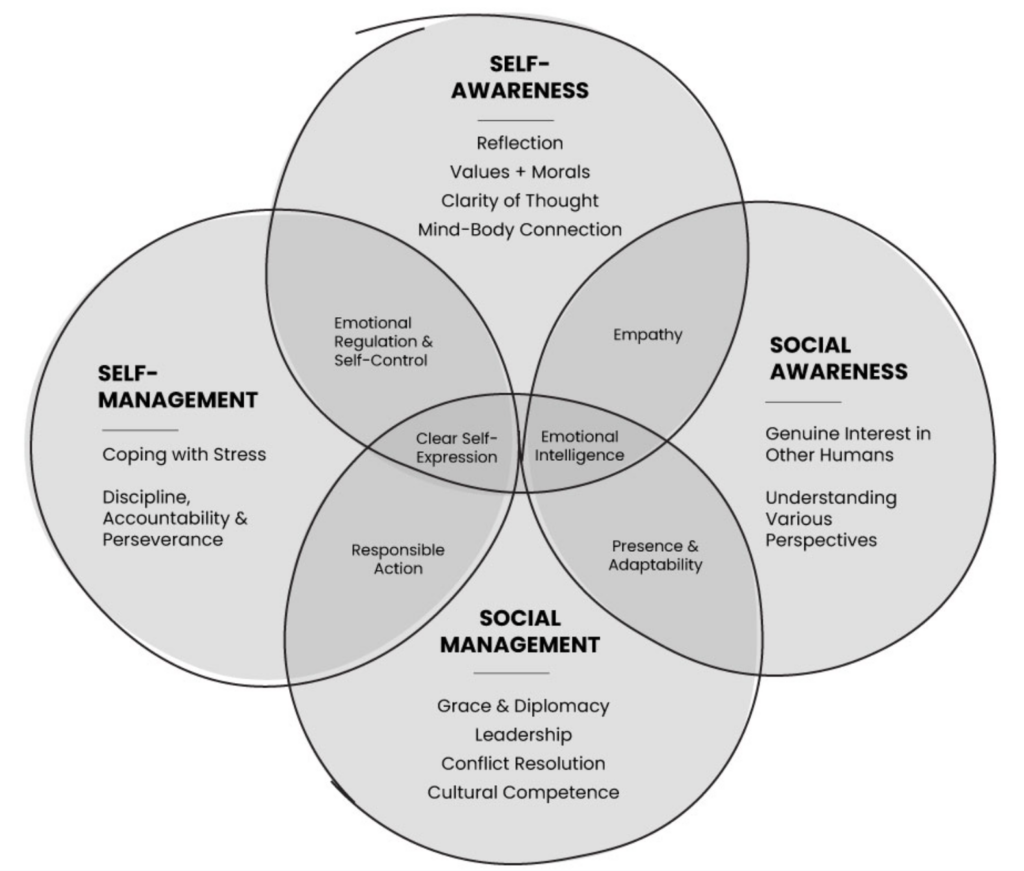
Leading balanced lives requires skills derived from each quadrant. Use this as a roadmap for assessing your current strengths and charting a path for growth in other areas.
✅ Social Awareness without ⛔ Self-Awareness, Self-Management, or Social Management
If you have this combination of skill deficiencies, with proficiency in social awareness–you are prone to putting others first but neglecting yourself. You tend to remain silent, even in the face of disrespect. You don’t want to cause trouble or ruin the vibe. Absorbing and facilitating the needs of others theoretically avoids conflict.
You are practiced at evaluating the emotional energy of the people around you. You think you’re self-aware–and you can be when you’re alone with your thoughts–but you struggle to consider your own values, beliefs, and desires on the spot. Remember, silencing yourself to keep the peace, ignoring disrespectful behavior, and avoiding difficult conversations is a form of dishonest speech.
Recognize When You’re Putting Others First at Your Own Expense
Set aside time for self-reflection. Journaling can be a helpful tool for exploring and tracking thoughts and their underlying feelings. Identify situations where you tend to prioritize others’ needs over your own and consider ways to start voicing your own needs.
Nuance! A Note About Boundaries When Putting Others FirstBoundaries are not telling another person how to behave. Rather, boundaries tell people how you will respond to a certain behavior. For example, “stop yelling” is not a boundary, it’s a command. “If you continue to yell, I am going to leave” is setting a boundary. Boundaries aren’t always set verbally. Sometimes, boundaries are more effectively maintained through your actions. For example, creating distance from someone who depletes your energy is setting a boundary. Whether or not a direct conversation is needed depends on the specific relationship dynamics and circumstances. Ultimately, the goal of boundaries is to maintain healthy connections with others. This is not about prematurely severing ties, but rather ensuring that the relationship can last under conditions conducive to mutual well-being. |