Defining Morality
We often think about improving morality as undergoing a character overhaul, or committing to something grand and noble. It brings to mind ideals of flawless behavior and unwavering virtue. Aristotle’s definition was simpler. Morality is anything that contributes to human well-being. Actions—and even inanimate objects—are “moral” if they support how people live and function.
That means we express our morality, or goodness, in the relationships we nurture, the activities we practice, the art we create, the impact we have in our jobs, and every other time we contribute effort without causing harm. We become moral through actions carried out with care for people. Not through grand charitable gestures, tightening the rules on ourselves, or by living under constant pressure to get everything right.
Morality, or being a good human, is to choose thoughtfully across various situations over time. To make decisions that reflect care, context, and consequence. Aristotle called this phronesis.
Being Good Humans Through Phronesis: The Wisdom of Action
Aristotle’s term for practical wisdom is phronesis, a form of knowing beyond scientific or theoretical knowledge and technical know-how. Phronesis is the wisdom of action. It can’t be developed through study. It is practiced. It takes shape as we experience life and adapt our decisions and approaches based on an evolving understanding of what is best for each situation. This is what turns virtues and morals into something lived.
“Phronesis is the true state, reasoned, and capable of action with regard to things that are good or bad for man.” – Aristotle
The Difference Between Morality and Virtue
Virtue is a more reliable measure of character than morality, because morality is often defined externally—through a set of standards, beliefs, or systems established outside of you. Virtue, on the other hand, is developed internally through lived experiences. Morals prescribe what is “right,” which makes them easy to turn into tools for control, conformity, or excessive behavioral policing. Virtue, on the other hand, is choosing what is right with nuance, discernment, and situational context. Morality is prescriptive. Virtue must be lived. And it’s phronesis that allows us to live it well.
Aristotle defined virtue as the middle ground between two extremes: excess and deficit. Harm is caused when we swing too far in either direction. For example, the virtue of courage fills the space between cowardice (a courage deficit: avoiding speaking up or taking action in situations that would benefit from it) and recklessness (an excess of courage: acting boldly without considering the consequences).
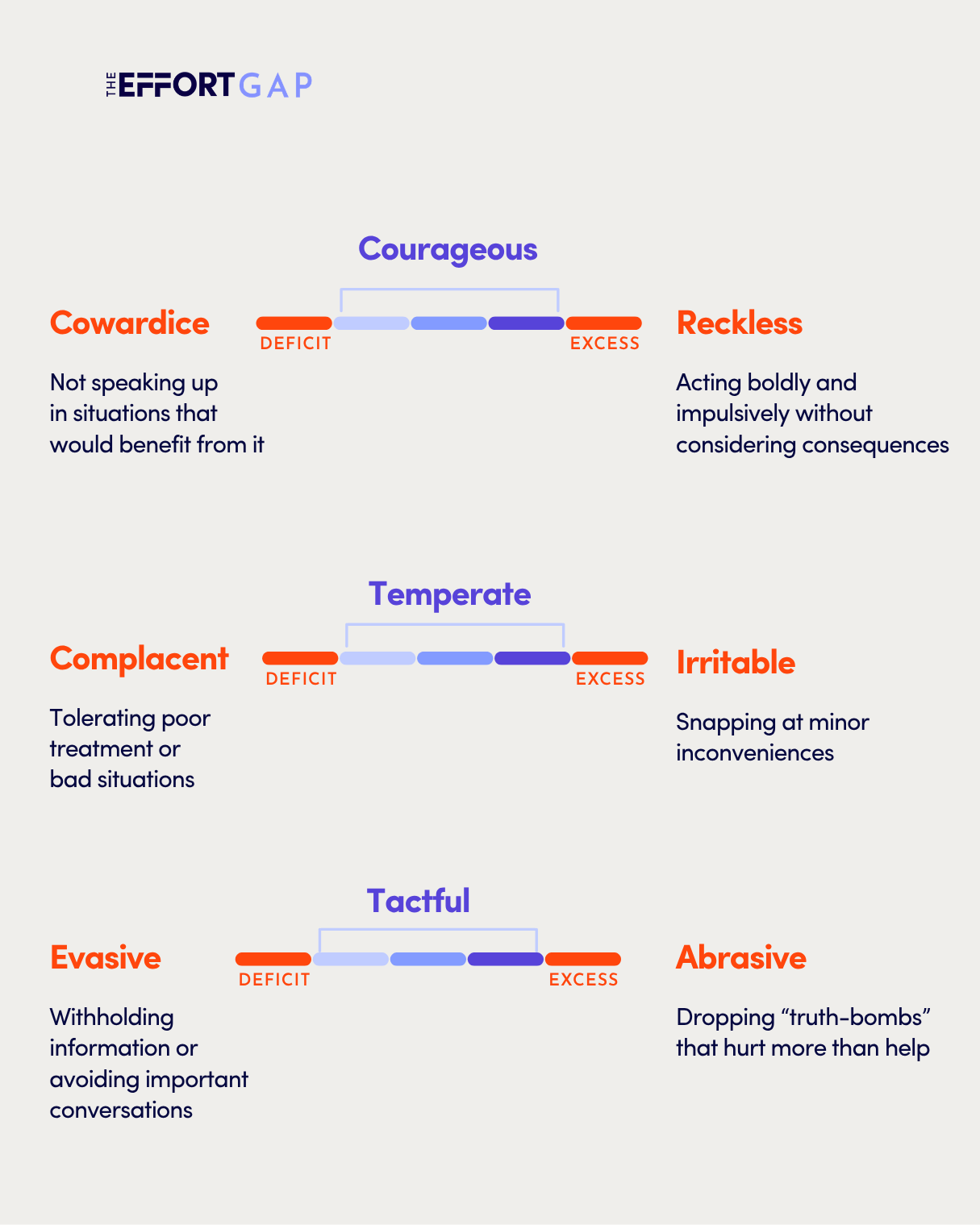
One cannot see from a deficit of light. One feels intense pain if exposed to an excess of light. Both are blinding.
“Courage is knowing it might hurt and doing it anyway. Stupidity is the same. That’s why life is hard.” -Jeremy Goldberg
Phronesis and Decision-Making
Teddy Roosevelt said, “knowing what’s right doesn’t mean much unless you do what’s right.” It’s true: knowledge only really matters when it’s applied. But how often is there a single, obvious, “right” action? Most situations are nuanced, with multiple reasonable ways forward. That’s where discernment comes into play.
Imagine you’re a parent facing a decision about your child’s education. You filter the decision through your own values. If you value self-efficacy, you might encourage your child to pursue their own path, even if it deviates from societal norms. Alternatively, if you value stability, you might guide them toward something more traditional to prioritize security. Both paths are valid. Both are justifiable. But justification isn’t the same as discernment. So you look more closely at the situation itself.
What’s your child’s comfort level with risk? Do they thrive in structured environments? What do they actually need right now? This is phronesis in action. It’s when your values, the specifics of the situation, and the needs of others all shape the decision.
So the objective isn’t arriving at a unilateral definition of what’s right. Phronesis is the ability to understand situational complexity, balance perspectives, and weigh consequences in real time. (Note: weighing consequences is not a permission slip to overthink every possible scenario or attempt to predict the future). Practical wisdom is pursuing a theory about what’s best, then adapting as new information, perspectives, and circumstances emerge. Good decision-making is about reflection, action, and refinement. This is how discernment sharpens. Not before action, but through it.
Reflection Matters as Much as the Decision Itself
Reflection after a decision is just as important as the decision itself. To continue on the example above, continuous feedback from your child’s experience, coupled with your understanding of their evolving needs, will guide you in adjusting your approach if needed. Is your child developing self-reliance, or are they struggling with the lack of structure? Do they feel motivated by the promise of stability, or is there an emerging desire to explore other paths? You have the option to change course or to apply what you’re learning to your next decision. You don’t have to get it right, you just have to be thoughtful.
Phronesis and Social + Emotional Intelligence
It takes a blend of competencies (self-awareness, self management, social awareness, and social management) to assess a situation, weigh different options, and make a responsible decision. It starts with self awareness. “I am anxious” isn’t a statement of self awareness. “Is this anxiety really a sign to quit, or am I just uncomfortable because I’m doing something new or important?” That’s effective self-awareness.
Next, move self awareness into action. To do this, notice how you speak or act, especially in emotionally charged situations. Do you tend to react quickly, or do you allow time for your emotions to settle? Practice pausing before reacting and ask: Is this an appropriate time to speak, or would listening and reflecting first allow me to act more thoughtfully? This is how you pair awareness with management. This is what supports discernment in practice: your ability to read yourself, others, and the moment accurately.
“Anyone can become angry—that is easy. But to be angry with the right person, to the right degree, at the right time, for the right purpose, and in the right way—that is not easy.” -Aristotle
Being a Good Human
Being a good human is not about memorizing moral codes or modeling flawlessly proper behavior. It’s about practicing judgment, adapting to circumstances, and applying effort towards things that are good for humankind (yourself and others). Knowing how to act, here, in this situation, with these people.
The Effort Gap is where this practice lives: clearing your mind so you can think clearly, leading yourself with intention instead of living on autopilot, and connecting with others in ways that uplifts them while expanding who you are.
Notice the pattern. Then choose differently.
Take the quiz to see where your effort is misaligned, or start with the free guide to shift out of overthinking and into action.