Without social awareness and relational skills, boundaries create distance rather than connection. Communicating your needs is important, but so is understanding how you impact other people.
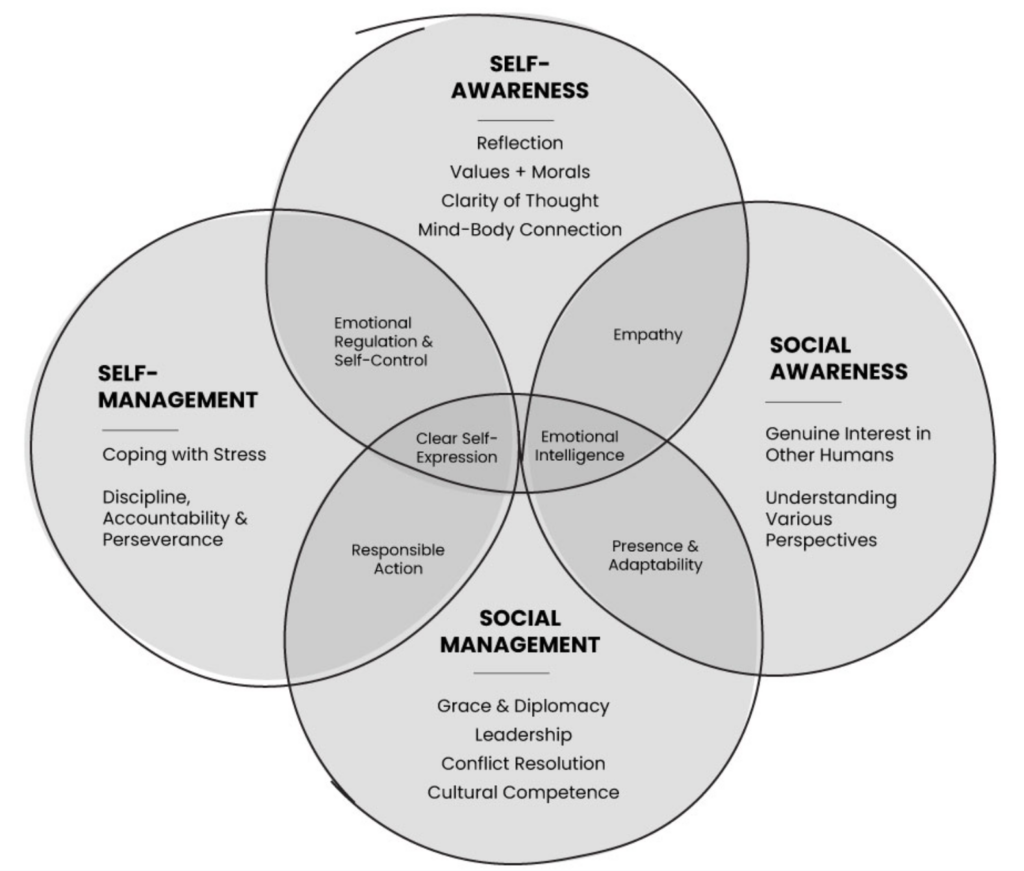
Look at human intelligence and wellness across four pillars:
-
- Self-Awareness (Know Yourself)
- Social Awareness (Know Others)
- Self Management (Lead Yourself)
- Relationship Management (Manage Relationships)
Understand Your Strengths and Areas for Growth
Leading balanced lives requires skills derived from each quadrant. Use this as a roadmap for assessing your current strengths and charting a path for growth in other areas.
✅ Having Self-Awareness without ⛔ Social Awareness and Management
On the flip side of struggling to set boundaries, self-awareness without social skills gives rise to the “boundary warrior.” The boundary warrior has no issue understanding their own needs and preferences. However, their communication of those needs often creates tension or distance, with little effort to understand the other person’s perspective.
This is a gap in both social awareness and social management. While they recognize the importance of boundaries, this person resists when others set boundaries in response to their behavior. They view other people’s boundaries as a threat to their freedom to behave as they wish. They don’t often grasp the impact they have on others, but they can still sense the tension. Feeling tension without the skills to understand or manage it creates emotional overwhelm. Without comprehension, the mind fills in the blanks with assumptions rooted in fear, shame, or defensiveness. “I must have messed up.” “They’re mad at me.” “This is going to get worse.” So they ghost. Ghosting bypasses the discomfort rather than enduring the labor of understanding, communicating, and repairing. They don’t disappear because they don’t care, but because they’re socially under-practiced.
This article about “therapy speak” by Rebecca Fishbein outlines how this plays out in conversation.
“Boundaries are important. But our relationships require a touch more compassion,” Fishbein says.
“Conflict can be difficult, and people might think they can avoid it by asserting their needs in a way that prevents the other person from responding — by using HR language to end a friendship, for instance, or via straight-up ghosting. And by couching the behavior in therapy language, the hard “boundary” can feel more legitimate, or even virtuous.”
Boundaries That Connect, Not Divide
When making decisions that affect other humans, consider their feelings and perspectives. This is the foundation for making responsible decisions, not just decisions that feel emotionally safe for you. Relationships thrive when we acknowledge the discomfort and keep putting in effort anyway. Relational growth happens when we stay in conversation, not when we shut it down.
There are appropriate times for ending relationships. Just make sure self-care doesn’t become an obstacle to human connection. Relationships don’t just happen to us. We have to build them through a sustainable rhythm of effort and understanding.
The idea that relationships are built does not imply a responsibility to “mother” or “fix” people. It emphasizes the mutual effort inherent to healthy relationships. Healthy relationships take mutual understanding while respecting individual autonomy. This is about growth and connection without taking responsibility for other people’s lives.
Boundaries as Self-Leadership, Not People Management
You might think that boundaries relate to social management, but they’re more about self leadership. Boundaries aren’t telling other people how to behave. They’re about how you manage yourself during moments of tension and disagreement.
Command: “Don’t talk to me like that.”
Boundary: “If you continue yelling, I’m going to step away.”
It’s self-leadership in real time: respectfully expressing your experience and managing your own response. Not draining your energy trying to control, change, or demand compliance from others.