Curious about how overthinking affects you and your decision making? A few factors are usually at play:
- Stakes + Complexity
- Anxiety Level (influenced by stakes + complexity)
- Level of Thought vs. Action (influenced by anxiety level)
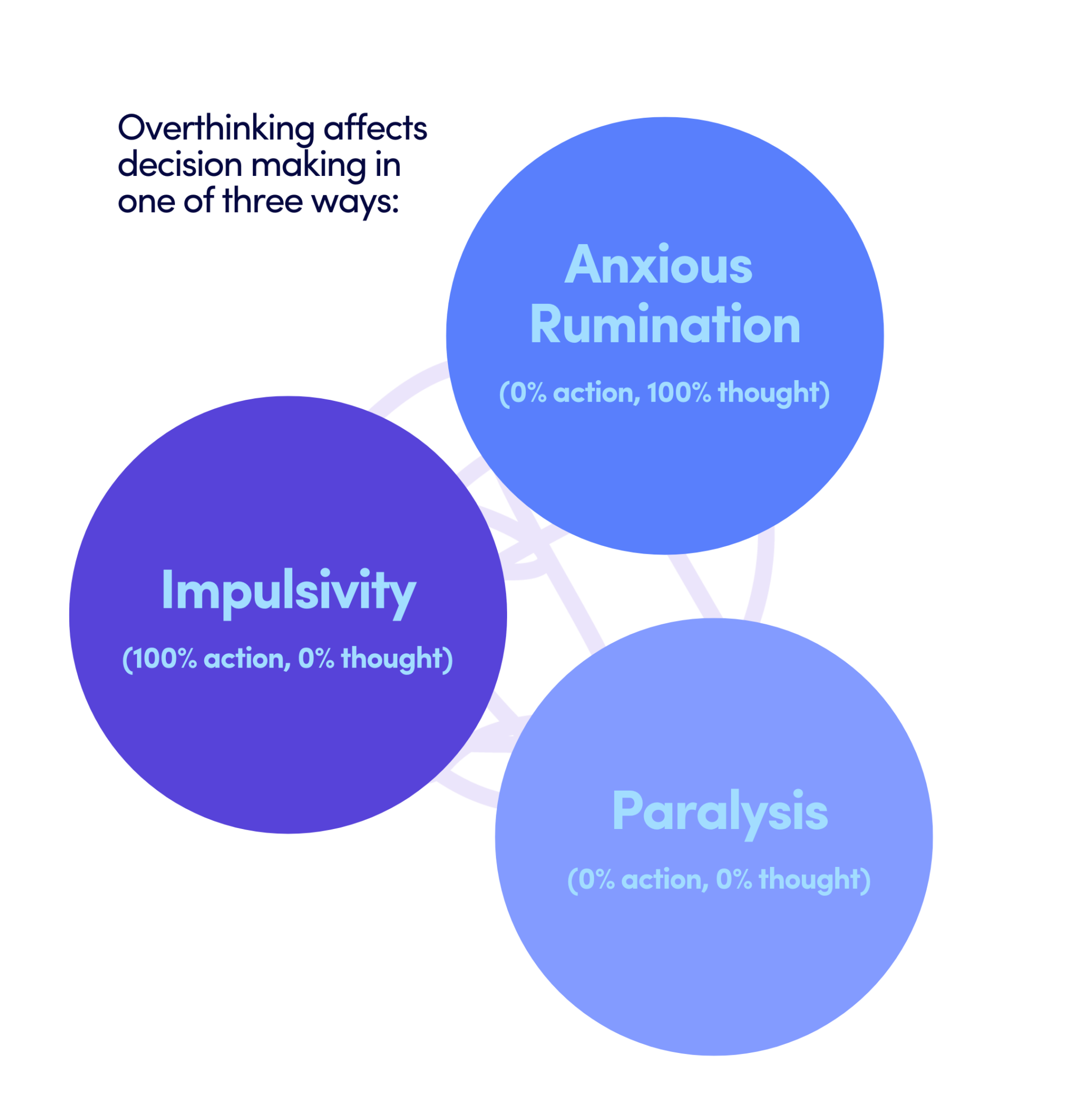
Overthinking affects responsible decision making in one of three ways:
- Anxious Rumination
- Impulsivity
- Paralysis
How Overthinking Affects You: #1 – Anxious Rumination
Overthinking in the form of anxious rumination works like this:
- Stakes + Complexity: high, complex
- Anxiety Level: high
- Thought vs. Action: 0% action, 100% thought
This kind of overthinking shows up when everything feels heavy. Too many factors, high emotions, potential fallout for others, and a fear of messing up. These choices aren’t always hard, but their complexity brings anxiety that makes it feel impossible.
“Don’t confuse the complex with the difficult. Most situations are simple, many are emotionally difficult to act upon.” – Tim Ferriss
Managing Anxious Rumination
There’s no single right answer for how to work on anxious rumination, but the goal is to work towards clarity of mind. This is a process of reduction, not adding MORE to your plate (more opinions, more information, more prep). Do activities that slow you down. That could be walking, writing, meditating, or connecting with humans who calm you.
How Overthinking Affects You: #2 – Impulsivity
Overthinking manifests as impulsivity when you overcorrect anxious rumination by jumping into action too quickly.
- Stakes + Complexity : varies
- Anxiety Level: high
- Thought vs. Action: 100% action, 0% thought
Managing Impulsivity
If you tend to act on impulse, practice buying yourself time. How much time depends on the complexity of the decision (maybe 5-minutes for simpler choices or a few days for something bigger). Step away. Let your mind settle.
Even if your first instinct seems right, allow time for a second or third thought to weigh in. In some cases, especially when other people are affected, it also helps to seek another point of view. Just remember: seeking input should complement your own judgment, not replace it and alleviate you from the responsibility of thinking things through and standing by your decisions.
How Overthinking Affects You: #3 Paralysis
- Stakes + Complexity: low, not complex
- Anxiety Level: low
- Thought vs. Action: 0% action, 0% thought
Unlike anxious rumination, paralysis happens when your nervous system isn’t activated by the decision. Your nervous system doesn’t have an opinion on Cheez-Its vs Flaming Hot Cheetos. It’s not concerned about whether your nails are cut round or square. Still, there’s pressure to make a choice. The decision might feel harder than it should, but it’s not a threat. When your nervous system isn’t activated and there’s no real risk, your brain doesn’t bother to propose questions or pathways forward. We usually deem any stall on decision-making “overthinking.” But in this case, it’s actually underthinking. Instead of analyzing too much, you’re not engaging your full thinking at all.
Breaking Free From Decision Making Paralysis
The reason you’re not engaging your full thinking is that you don’t have to. The stakes are low. Just choose. This is your opportunity to practice self leadership in making decisions. The pressure you feel isn’t because the decision is scary or high consequence, it’s got something to do with the ego. Maybe the ego is concerned with the people behind you in line being annoyed by you. Or maybe it thinks you might appear incompetent or unprepared if you can’t make a decision quickly. Make a choice, stand by it, and learn from it.
How Overthinking Affects You and Your Relationships
When people see that you consider consequences and perspectives and act with integrity, they trust you. The way you make decisions teaches people how safe, reliable, and considerate you are. This will take you far in building and sustaining relationships.
Decision-making isn’t just about the choice itself. It’s a practice of strengthening your ability to manage emotions, tolerate uncertainty, and behave in alignment with your values. This is what Aristotle called practical wisdom: not just knowing what’s right, but acting on it, in context.
Responsible decision-making takes effort. Pausing, communicating, and sometimes choosing the harder path. That sustained effort builds resilience, maturity, and fulfillment.
Notice the pattern. Then choose differently.
Take the quiz to see where your effort is misaligned, or start with the free guide to shift out of overthinking and into action.